
The clinical evidence supporting Rb-82 PET MPI is compelling and well documented. The key challenge now is translating that evidence into institutional value. What does adoption mean for your hospital’s competitive position, operational efficiency, patient care pathway, and financial performance? We will examine the programme-level economics of implementation, including the expected costs, benefits, and strategic advantages of incorporating Rb-82 PET MPI into clinical practice.
The Clinical Foundation
What the technology does :
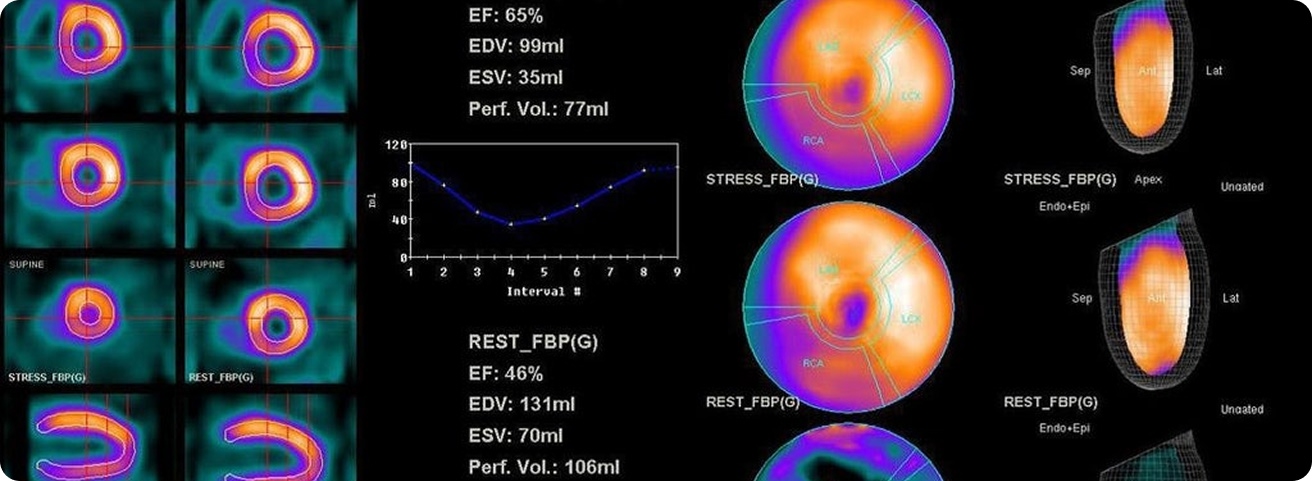
Rb-82 PET MPI measures both relative myocardial perfusion (identifying which areas of the heart have reduced blood flow) and absolute myocardial blood flow (quantifying exactly how much blood is delivered to each gram of heart muscle per minute). It does this at a radiation dose of approximately 3 mSv, less than one-third of the dose from most conventional SPECT protocols [1].
Why it matters clinically:
The addition of absolute blood flow quantitation detects two conditions that relative imaging systematically misses:
1. Balanced ischaemia: In patients with severe disease in all three coronary arteries, every territory is equally underperfused, so a relative comparison looks normal. Absolute flow measurement reveals the true physiological compromise.
2. Microvascular dysfunction (INOCA): Patients with angina but no obstructive coronary disease often have impaired blood flow at the level of the small vessels. These patients cycle through repeated investigations until the problem is correctly identified. Quantitative PET solves this in a single study.
Why it matters to patients:
A patient who receives the correct diagnosis in a single, low-dose PET study rather than after three or four inconclusive investigations is a patient who starts the right treatment sooner, with less cumulative radiation, and with higher satisfaction.
The Volume Opportunity
The Core Perfusion Market
Coronary artery disease remains the leading cause of death and disability in Southeast Asia. The population eligible for functional cardiac imaging are symptomatic patients with intermediate pre-test probability, patients with abnormal coronary CT findings, patients with unexplained dyspnoea. This is a large and growing population with an ageing demographic profile.
A PET MPI programme that positions itself as the clinical reference standard for this population will attract referrals that conventional SPECT programmes cannot claim. The performance differentiation is real, documented, and increasingly recognised by referring cardiologists who are tracking the nuclear cardiology literature.
The Expanding Indication Set
Beyond the core perfusion indication, the same PET/CT infrastructure supports a growing list of additional cardiac imaging applications, each representing a distinct, recurring patient population:
Each indication is a distinct referral pathway from a different clinical specialty. A PET/CT scanner that serves all of these indications generates more studies per scanner day, a more diversified revenue base, and a stronger case for capital investment than a scanner dedicated to a single indication.
The HFpEF Demand Funnel
Heart failure with preserved ejection fraction deserves specific mention. It is one of the largest and fastest-growing cardiovascular syndromes in the region, driven by ageing populations, rising hypertension and diabetes prevalence, and improving survival from coronary artery disease. A programme that develops a recognised HFpEF imaging service, combining perfusion and flow quantitation for ischaemia and microvascular disease assessment, amyloid screening with PYP, and FDG-PET for inflammatory evaluation, can play an important role in the evaluation of selected HFpEF patients and related conditions.
The Dose Advantage: A Commercial and Clinical Differentiator
The radiation dose associated with cardiac imaging is increasingly scrutinised by payers, hospital quality programmes, and informed patients. The ASNC has established ≤9 mSv as the target for cardiac radionuclide imaging. Rb-82 PET MPI achieves approximately 3 mSv, a threefold margin below that target. This is a key differentiator that:
- Supports repeat imaging: Patients with chronic coronary disease require serial imaging over years or decades. A programme that minimises per-study dose enables appropriate monitoring without accumulating an excessive lifetime dose.
- Expands eligible patient populations: Younger patients, women of childbearing age, and patients who have expressed radiation concern are more likely to consent to a low-dose programme.
- Strengthens payer and quality conversations: Hospital quality metrics increasingly include radiation dose management. A PET programme at 3 mSv is a demonstrably superior programme for any hospital competing for accreditation, payer contracting, or quality recognition.
- Differentiates from SPECT competition: Conventional SPECT protocols at 12–15 mSv are difficult to defend clinically when a PET alternative delivers superior quantitative accuracy at one-fifth the dose.
The Supply Model: Generator-Based, No Cyclotron Required
A frequent point of misconception during the evaluation of PET MPI is the infrastructure requirement. Rb-82 is a cyclotron-product tracer, and its parent isotope, strontium-82, is cyclotron-produced, but the generator model eliminates the need for an on-site cyclotron.
The Rb-82 generator operates on the same principle as the technetium-99m generators already in use in nuclear medicine departments throughout the region. The generator, pre-calibrated and quality-tested, is delivered to the site. Rb-82 is eluted from the generator at the time of use and administered to the patient within seconds. No radiochemistry facility. No on-site cyclotron. No requirement for a separate production infrastructure.
The supply chain model, generator delivery on a defined schedule with a confirmed supply agreement, is straightforward to plan and budget. The regulatory pathway for generator import and use is defined and navigable in major Southeast Asian markets.
The Cost Structure
A PET MPI programme's cost structure includes:
Capital equipment:
A dedicated cardiac PET/CT scanner or an integrated PET/CT system. For programmes that already operate PET/CT for oncology indications, dedicated cardiac time can be scheduled on an existing platform, substantially reducing incremental capital investment.
Rb-82 generator service:
Generator supply agreements are structured as periodic delivery contracts, typically with a fixed per-generator cost and a defined number of patient doses per generator. Per-study generator cost declines with utilisation, programmes with higher daily scan volumes have a more favourable unit economics profile.
Staff training and protocol development:
Technologist training for dynamic acquisition and kinetic modelling QC, physician training for quantitative MBF reporting, and referrer education for appropriate indication selection are one-time investments that compound over time.
Ongoing operational costs:
Pharmacological stress agents, power injector supplies, software licensing for kinetic modelling, and routine maintenance.
The Utilisation Model
PET MPI economics improve materially as daily utilisation increases. Key to utilisation is breadth of indication: a scanner that runs Rb-82 perfusion in the morning and FDG sarcoidosis or endocarditis studies in the afternoon generates more revenue per scanner-day than one restricted to perfusion imaging. The multi-indication model is not just clinically justified, it is economically superior.
Key Questions for Planning
The following questions should be addressed for a Rb-82 PET MPI programme:
What is the current volume of SPECT MPI studies at your institution, and what proportion would shift to PET if PET were available?
Historical SPECT volume is the primary basis for PET volume projection.
What is the existing PET/CT infrastructure?
An existing oncology PET/CT system may be schedulable for cardiac time, reducing capital expenditure substantially.
What is the referral base for non-perfusion PET indications?
Cardiac sarcoidosis, amyloid, endocarditis, and vasculitis referrals from rheumatology, infectious disease, and haematology represent additional volume that a broader cardiac PET programme can serve.
What are the relevant reimbursement codes in your market?
Reimbursement landscape varies by country across Southeast Asia. QT Instruments can provide current reimbursement status for Rb-82 PET MPI in your specific market and support engagement with national payers.
What is the competitive landscape?
Is there a PET MPI programme within your patient referral geography? If so, what clinical differentiation will your programme offer? If not, first-mover positioning in a tertiary referral network is a meaningful strategic advantage.
Summary: The Business Case in Brief
Next Steps
QT Instruments supports hospital programmes across Southeast Asia in developing the business case, clinical strategy, regulatory pathway, and operational infrastructure for Rb-82 PET MPI programmes. We provide:
- Site assessment and volume modelling
- Generator supply structuring and regulatory navigation
- Protocol development and staff training
- Referrer engagement and KOL programme design
- Payer and HTA support for reimbursement engagement
To begin a programme assessment, contact QT Instruments.
QT Instruments (under Biomedia Holdings) supports nuclear cardiology programmes across Southeast Asia in establishing and optimising quantitative perfusion capabilities, including Rb-82 PET infrastructure and clinical training.
Editorial Note: The content of this article has been prepared using educational material, scientific presentations, and key takeaways from the ASCI 2026 Congress, Singapore. This brief is intended as an educational and planning resource.
References
Case, J. A., deKemp, R. A., Slomka, P. J., Smith, M. F., Heller, G. V., & Cerqueira, M. D. (2017). Status of cardiovascular PET radiation exposure and strategies for reduction: An information statement from the Cardiovascular PET Task Force. Journal of Nuclear Cardiology, 24(4), 1427–1439. https://doi.org/10.1007/s12350-017-0897-9